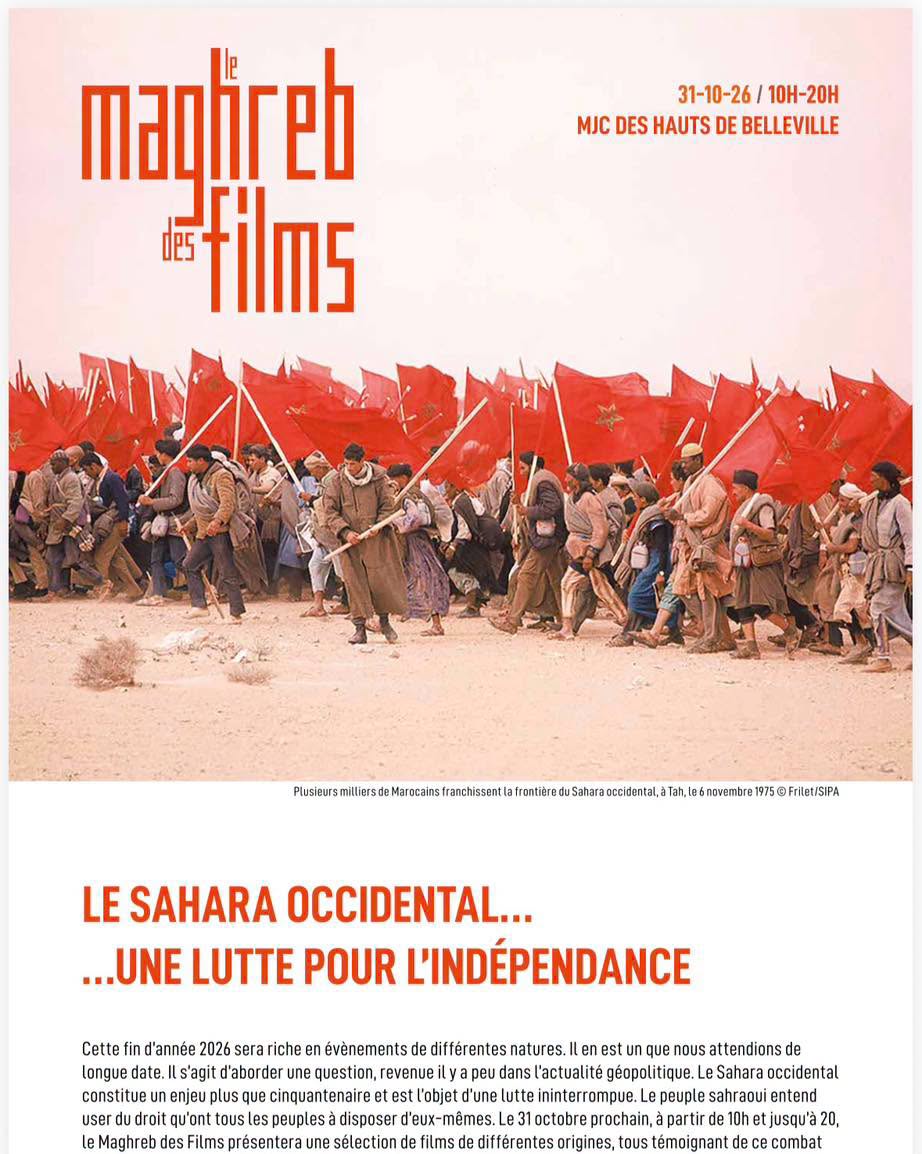
The association Le Maghreb des Films is organising a film event dedicated to Western Sahara entitled “Western Sahara: A Struggle for Independence”. It will take place on Saturday, 31 October 2026, from 10:30 a.m. to 8:00 p.m. at the MJC des Hauts de Belleville in Paris. The event will offer a selection of films from different backgrounds documenting the Sahrawi people’s struggle for self-determination and independence, and will conclude with a roundtable discussion moderated by historian Gilles Manceron, featuring participants including Karim Baba Miské and Claude Mangin. The programme will explore the history of the Western Sahara conflict, the struggle of the Polisario Front, and the Sahrawi people’s resistance to the Moroccan occupation.
Presentation
The association Le Maghreb des Films is dedicating a film event to Western Sahara entitled “Western Sahara: A Struggle for Independence”. The event will take place on Saturday, 31 October 2026, from 10:30 a.m. to 8:00 p.m. at the MJC des Hauts de Belleville in Paris. The initiative takes place against a backdrop in which the question of Western Sahara has once again come to the forefront of international geopolitical affairs. More than fifty years after the conflict began, the Sahrawi people continue to assert their right to self-determination.
The event offers a selection of films from different backgrounds and periods documenting the Sahrawi people’s struggle for independence, from the early years of the conflict to contemporary forms of resistance. The films address the formation of the Polisario Front, armed struggle, independence claims, and the situation of those who defend the Sahrawi cause. Through testimonies, archival footage and documentaries, the programme offers different perspectives on the history of the territory and the experiences of its population.
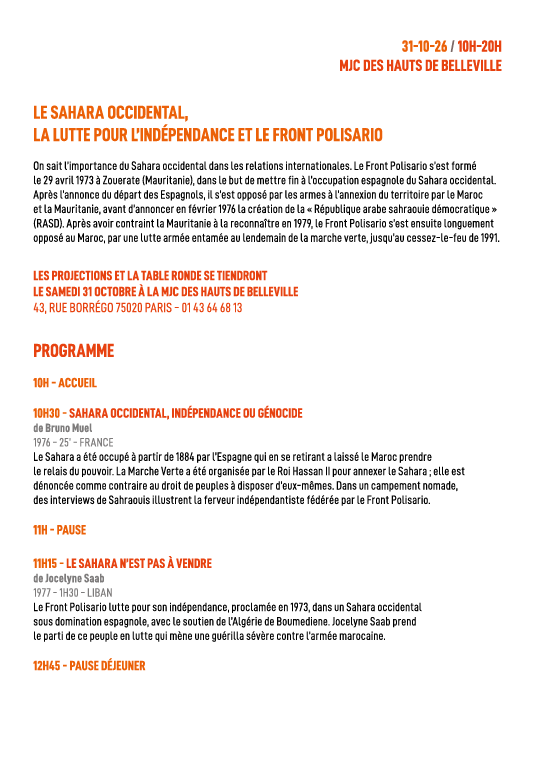
The association’s catalogue traces the origins of the Polisario Front to 29 April 1973 in Zouerate, Mauritania, with the initial aim of ending Spanish occupation of Western Sahara. Following Spain’s withdrawal, the movement opposed the annexation of the territory by Morocco and Mauritania and proclaimed the Sahrawi Arab Democratic Republic (SADR) in February 1976. After Mauritania recognised the SADR in 1979, the conflict continued between the Polisario Front and Morocco until the 1991 ceasefire, following years of armed struggle.
The event will conclude with a roundtable discussion moderated by historian Gilles Manceron, featuring several participants, including Karim Baba Miské, son of Ahmed Baba Miské, and Claude Mangin, wife of Naâma Asfari, a Sahrawi activist imprisoned in Morocco. The programme is dedicated to Naâma Asfari and Ahmed Baba Miské.
Aims and themes of the event
The initiative aims to raise awareness of the Sahrawi people’s struggle for independence through cinema and audiovisual testimony. The selection of films provides an opportunity to explore different stages of the conflict, from independence claims in the 1970s to the difficulties faced by those who continue to defend the right to self-determination.
The programme also addresses different forms of political, social and cultural resistance, as well as the tensions between strategies of non-violent struggle and armed resistance. The selected films offer a historical perspective on the occupation of the territory and the trajectory of the Polisario Front, while highlighting the individual experiences of those involved in defending the Sahrawi cause.
The screening of Dis-leur que j’existe (Une histoire sahraouie), which focuses on Naâma Asfari and his wife, Claude Mangin, connects the history of the conflict with contemporary demands for human rights and justice. The final roundtable discussion will extend the debate by bringing together perspectives from activists, journalists, researchers and historians.
Film programme
The event includes the following films:
-
Sahara occidental, indépendance ou génocide, by Bruno Muel (1976, 25 minutes, France). Through interviews with Sahrawi people in a nomadic camp, the documentary shows support for independence and the role of the Polisario Front in advancing this demand.
-
Le Sahara n’est pas à vendre, by Jocelyne Saab (1977, 1 hour 30 minutes, Lebanon). The film explores the Polisario Front’s struggle for Western Sahara’s independence and resistance to the Moroccan army.
-
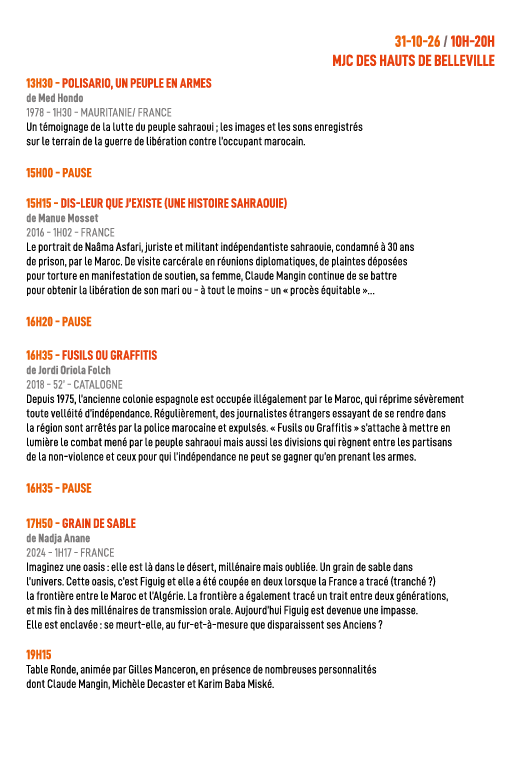
Polisario, un peuple en armes, by Med Hondo (1978, 1 hour 30 minutes, Mauritania/France). The documentary brings together testimonies and footage recorded on the ground during the Sahrawi people’s war of liberation.
-
Dis-leur que j’existe (Une histoire sahraouie), by Manue Mosset (2016, 1 hour 2 minutes, France). The film portrays Naâma Asfari, a lawyer and Sahrawi independence activist sentenced to thirty years in prison in Morocco, and follows Claude Mangin’s efforts to secure his release or a fair trial.
-
Fusils ou Graffitis, by Jordi Oriola Folch (2018, 52 minutes, Catalonia). The documentary explores the Sahrawi people’s struggle and the differences between those who advocate non-violent resistance and those who believe independence can only be achieved through armed struggle.
The catalogue also includes a film by Nadja Anane (2024, 1 hour 17 minutes, France) about Figuig, an oasis divided by the border between Morocco and Algeria, and the consequences of this division for cultural transmission between generations. The title is not clearly legible in the copy consulted.
Roundtable discussion
Following the screenings, a roundtable discussion will be held, moderated by historian Gilles Manceron, with several participants connected to Sahrawi history and the Sahrawi cause. Those announced include Karim Baba Miské, son of Ahmed Baba Miské, and Claude Mangin, wife of Naâma Asfari.
The discussion will provide an opportunity to explore further the issues raised by the films and reflect on the history of the conflict, demands for independence and forms of commitment to the Sahrawi cause.
Practical information
The event will take place on Saturday, 31 October 2026, from 10:30 a.m. to 8:00 p.m., at the MJC des Hauts de Belleville, located at 43 rue Borrego, 75020 Paris, France.
The programme will run over a single day, with successive film screenings and breaks between films, and will conclude with the roundtable discussion moderated by Gilles Manceron.
Organising organisation: Le Maghreb des Films.
Venue: MJC des Hauts de Belleville, 43 rue Borrego, 75020 Paris, France.
Date and time: 31 October 2026, 10:30 a.m.–8:00 p.m.
31.10.2026
31.10