


Series “Les Hommes aux semelles de vent” hosted by Aude-Émilie Judaïque on France Culture
5th Episode : “Les Sahraouis, enfants des nuages” (1h50) – 10.07.2015
Abstract
• PART 1 : Historical documentation
“Les Sahraouis, enfants des nuages”, with Sophie Caratini, anthropologist, author of La République des sables : anthropologie d’une Révolution (L’Harmattan, 2003).
Until the Spanish left Western Sahara, Sahrawi people were nomads. Their migrations followed the rain, hence their nickname “children of clouds”. But since decolonization in 1976, Sahrawi territories have been occupied by the Moroccan army and settlers. From now on, the settled population lives in refugee camps, separated from Mauritania by a “wall of sand” – the longest in the world – set in the middle of sand dunes. This is the place where is now being built the new Sahrawi identity based on the dream of a finally autonomous nation.
• TRANSITION : Testimony
Born in Western Sahara during the Spanish protectorate, the sociologist Ali Omar Yara has sought shelter in France after 15 years spent in Morocco. The estrangement with his native land has only strengthen his commitment to the Sahrawi cause.
• PART 2 : Set of experts – Settlement policy in the Moroccan South
As Morocco prepares to celebrate the Green March’s 40 years anniversary, let us take stock of the Moroccan colonization in Western Sahara during the second hour, with the sociologist Ali Omar Yara, the anthropologist and professor at Paris Descartes University Sébastien Boulay, the political specialist and researcher at the Maghreb Europe Institute of the Paris VIII – Saint-Denis University Marguerite Rollinde and the singer Oum who will provide us with a musical interlude.
• CONCLUSION : Testimony
The singer Oum was born in Casablanca in the year 1978. Her full name “Oum el Ghaït” was given to little girls born in the desert on a rainy day. So, Moroccan or Sahrawi ? How can we know ? Oum is Sahelian : a border-woman, a children of the rain. Here, she offers us her personal vision of Sahara.
Oum will be performing on July 25th 2015 during the Robion festival in the Vaucluse and her newest album “Zarabi” will be out on September 22nd 2015.
• READINGS :
The Palestinian singer Kamilya Jubran has put her sensitibility and generosity at the service of Sahrawi from yesterday and today by reading a loose adaptation of Sophie Caritini’s novel La fille du chasseur (Thierry Marchaisse editions, 2011) and poems extracted from the collections L’an prochain à Smara by Diego (2007) and La plume prisonnière by Na’ana Labbat El-Rachid (2008), both edited by L’Harmattan.
The comedian Mahmoud Saïd has embodied late Hassan II.
The sociologist Ali Omar Yara has read for us an excerpt of Voyage by Malainine Lakehal, a co-edition by L’Harmattan with the Arab Sahrawi Democratic Republic (RASD).
• END OF THE SHOW : Broadcasted songs at the end of the documentary
“Hijo de las nubes” by the Sahrawi singer Aziza Brahim and “Salam” by the Moroccan singer Oum
À lire aussi
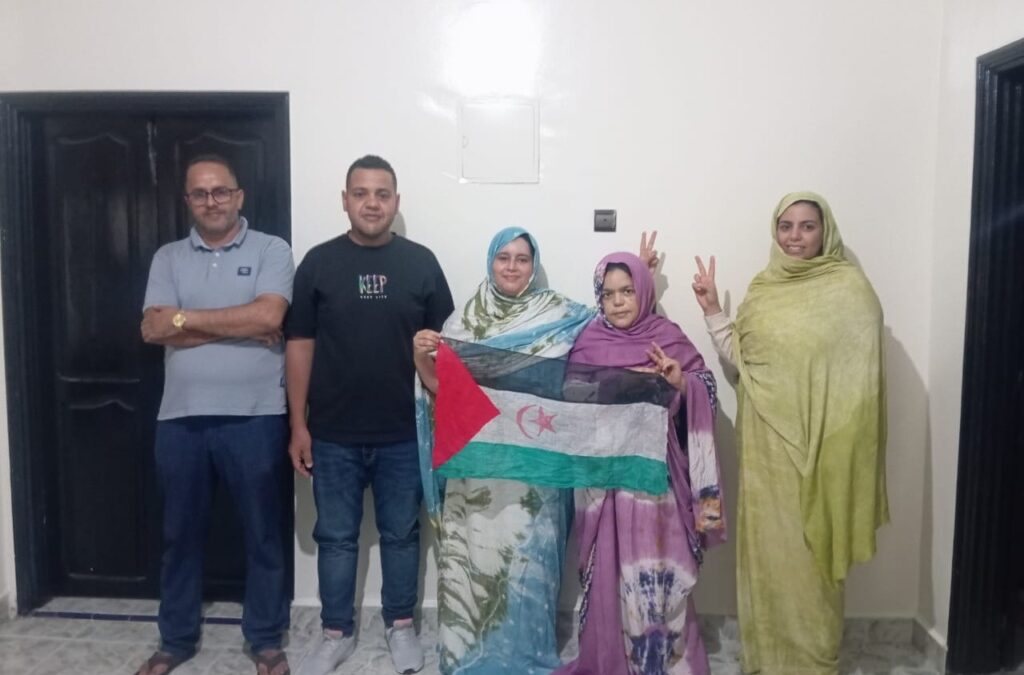
CODESA Press Release: A delegation from the Collective of Sahrawi Human Rights Defenders in Western Sahara (CODESA) visits the families of several Sahrawi political prisoners on hunger strike
According to the press release issued by CODESA on October 3, 2026: "On October 1, 2026, a group of members of the Collective of Sahrawi Human Rights Defenders in Western Sahara (CODESA) visited several families of Sahrawi political prisoners belonging to the Gdeim...
New Article “Statehood in Exile: The Sahrawi Arab Democratic Republic”
Spain, the colonial administrator of Western Sahara, entered into an agreement with Morocco and Mauritania in 1975. The agreement conceded to territorial claims of Morocco and Mauritania. The people of Western Sahara resisted the agreement and the subsequent...
New Article “Enquêter dans les camps de réfugié·es saharaoui·es : retours de terrain en Algérie et en République arabe saharaouie démocratique”
What does it mean to investigate the history of Western Sahara from within Sahrawi refugee camps and the Algerian institutions that have accompanied its internationalisation? Drawing on two periods of fieldwork conducted in 2025 in Tindouf and Algiers, this article...
New Article “Drawing Lines in the Sand: Cartography and Boundary-Making in Colonial Western Sahara”
This article aims to reflect on the role of cartography in the delimitation and demarca- tion of colonial spaces associated with desert environments. The first part of the chapter reflects on the particularities of boundary making processes in such environments, with...